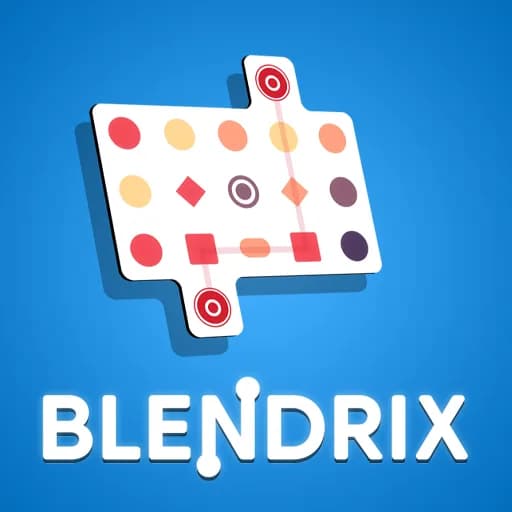
Blendrix Game Guide: Mastering the One-Other-Color Dots Rule
August 7, 2026 · MurderMafia.net Editorial Team · 4 min read
Blendrix has the simplest rule I have ever seen in a puzzle game, and the hardest applications. Connect two dots of the same color and everything between them changes to that color — but the connection only works if exactly one other color fills the space between. That single restriction turns a grid of colored dots into a logic labyrinth. Blendrix has taken over my quiet hours, and the best part is that it never rushes me.
The Rule That Makes It a Puzzle
If you could connect any two same-colored dots, the game would be trivial. The one-other-color rule is what creates the depth. A line that looks legal at a glance fails because two colors sit in between, and a line that looks impossible works because the middle strip happens to be uniform. The rule forces you to see the grid as zones, not dots — every move is really a statement about an entire region of the board, and the board changes after every statement.
Planning Three Moves Ahead
The best players are not the ones who react to the current board. They are the ones who read the board backward: to finish with one color, what did the board look like one move ago? That reverse thinking is the whole skill. A strong early move sets up a chain where each connection clears the path for the next, and the difference between a seven-move solution and a four-move solution is almost always in the first two moves. The game tracks your efficiency silently — finishing in fewer lines feels better, and the undo button makes trying ideas free.
Undo Is a Feature, Not a Cheat
The undo button (the double chevron) is the game's best teaching tool. A wrong line does not cost you the level; it costs one step back. That changes how you play entirely. Instead of restarting after a mistake, you can branch: try the bold line, watch the board react, undo it, try the careful line. The freedom makes experimentation feel safe, which is exactly what a puzzle about logical leaps needs. The game trusts you to learn, and the undo button is the trust made visible.
When Directional Dots Arrive
Later levels introduce dots that only accept connections from specific directions. The symmetrical habits you built in the early grids stop working, and the game becomes a routing problem — you are no longer connecting colors, you are finding paths through a grid with one-way doors. It is the moment Blendrix stops being relaxing and starts being genuinely hard, and it is the moment the puzzle earns its keep.
Fans of quiet logic puzzles should also try Brain Lines, which swaps dots for drawn ramps but keeps the same test-a-theory loop. Blendrix runs free in your browser with no timer and no pressure — just you, the grid and the one-other-color rule that somehow never gets old.